


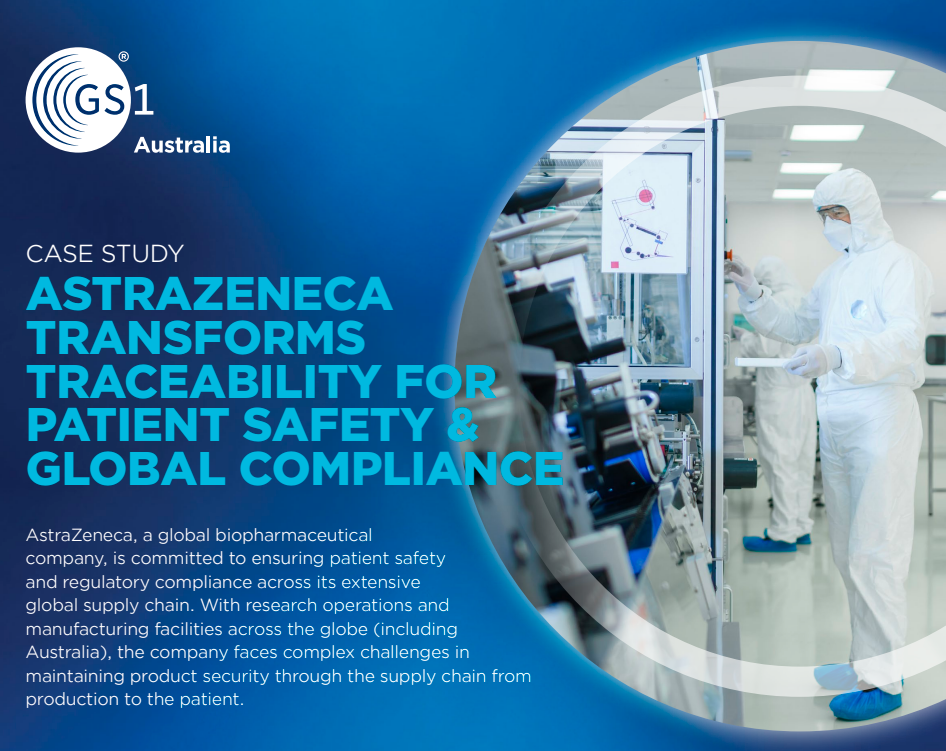

What the AstraZeneca experience reveals about building safer, smarter and more connected pharmaceutical supply chains in Kenya
A medicine may begin its journey on a manufacturing line, but its responsibility does not end when it leaves the factory. Before it reaches a patient, a pharmaceutical product can pass through manufacturers, warehouses, distributors, transporters, wholesalers, pharmacies and healthcare facilities. At every stage, the ability to answer basic questions becomes critical: Where did the product come from? Which batch is it? When does it expire? Who handled it? Where is it now? And if something goes wrong, can it be identified and recalled quickly?
For pharmaceutical manufacturers, traceability is therefore becoming more than a supply-chain function. It is increasingly a foundation for patient safety, product security, regulatory compliance and trust. As pharmaceutical supply chains become more interconnected and regulatory expectations around product identification and traceability continue to evolve, manufacturers need systems that allow reliable information to move with the product throughout its journey.

The experience of global biopharmaceutical company AstraZeneca offers an important perspective on what this can look like in practice. A GS1 Australia case study documents how AstraZeneca adopted GS1 global standards as part of its approach to traceability, serialisation, packaging and regulatory reporting. The experience demonstrates how standardisation can help pharmaceutical organisations connect product identification with operational processes and create greater visibility across the supply chain.
The lesson extends beyond AstraZeneca. Traceability is not simply about putting a barcode on a medicine. It is about creating a connected chain of trusted information around that medicine, from the point where it is manufactured to the point where it is received and ultimately used.
At the centre of AstraZeneca’s approach is the use of GS1 DataMatrix to encode important product information, including the Global Trade Item Number, serial number, expiry date and batch number. The case study describes how these identifiers support unique product identification and serialisation at the manufacturing stage.
This distinction is increasingly important for pharmaceutical manufacturers. A traditional barcode may identify a product, but a two-dimensional barcode such as GS1 DataMatrix can carry additional information that helps distinguish not only what the product is, but also which batch it belongs to, when it expires and, where applicable, which individual serialised unit is being handled. This creates an opportunity to move from simply identifying a product to establishing a digital identity that can accompany it through the supply chain.
For manufacturers operating across different markets, standardisation can also help reduce complexity. AstraZeneca’s experience provides a striking example. According to the GS1 Australia case study, the implementation of a new non-GS1-compliant product at one Australian site required nine months for system development, configuration, documentation, testing and training. A later product that was fully GS1 compliant took one month to implement. The case study attributes this difference to the ability of standardisation to simplify configuration and reduce the need for additional processes and customisation.
This highlights a broader point about digital transformation in healthcare: interoperability matters. When every system, market or supply-chain partner uses different identifiers and data structures, connecting them can become costly and complicated. Global standards provide a common language through which products, locations and supply-chain events can be consistently identified and information can be exchanged.
GS1’s approach to traceability is built around three interconnected activities: identifying products and other entities, capturing information about them and sharing that information across the supply chain. For pharmaceutical manufacturers, this means the barcode is only one component of a much larger traceability ecosystem. Its value increases when product identification, data capture and data sharing are connected.
This perspective is particularly relevant to Kenya’s pharmaceutical sector. The country’s healthcare supply chain is becoming increasingly digital, while the need for product authentication, visibility and traceability continues to attract attention. The Pharmacy and Poisons Board has published standards for authentication and traceability of health products and technologies, highlighting the importance of technologies that can support monitoring of supply-chain integrity and product movement.
For pharmaceutical manufacturers in Kenya, this presents an opportunity to look at traceability not simply as a regulatory requirement, but as part of a broader supply-chain strategy. The starting point is product identification. GTINs can provide unique identification for pharmaceutical products, while serialisation can distinguish individual units where required. GS1 DataMatrix can carry information such as the GTIN, batch or lot number, expiry date and serial number. Beyond the product itself, GLNs can identify organisations and locations involved in the supply chain, while SSCCs can identify logistics units such as cases and pallets.
When these identifiers are connected, the result is more than a collection of barcodes. It becomes a framework through which the product, the organisations handling it and the locations through which it moves can be consistently identified.
True traceability, however, requires visibility beyond the manufacturing line. GS1’s Global Traceability Standard uses the concepts of Critical Tracking Events and Key Data Elements to provide a structured way of understanding what happens to a product as it moves through the supply chain. Events such as receiving, packing, shipping and transporting can generate data that helps establish the history and movement of a product.
For a pharmaceutical manufacturer, this could mean identifying a product when it is manufactured, capturing its information during packaging, linking it to its case or pallet, recording its dispatch, capturing its receipt by a distributor and maintaining visibility as it moves through subsequent stages of the supply chain. The objective is not simply to know that a product exists, but to establish where it has been, what happened to it and where it is supposed to be.
Perhaps one of the clearest tests of a traceability system is what happens when a product needs to be recalled. If a particular batch is affected, how quickly can the manufacturer identify the relevant products? Can it determine which distributors or facilities received them? Can it identify the locations where the products are currently held? And can it distinguish the affected products from other batches?
Standards-based identification and traceability can support more targeted recall processes because products can be identified at batch or serial level. Instead of relying entirely on broad distribution records and manual searches, manufacturers can use structured data to establish the movement of affected products and communicate with the relevant supply-chain partners.
This is where the role of GS1 Kenya becomes particularly relevant to pharmaceutical manufacturers. As Kenya’s GS1 Member Organisation, GS1 Kenya supports businesses in implementing GS1 standards for product identification, barcoding and traceability. Its healthcare services include GS1 DataMatrix, product identification, location identification and traceability, while its consultancy services cover areas such as supply-chain optimisation, traceability and recall readiness, data quality, serialisation, product authentication and system integration.
For a pharmaceutical manufacturer considering the move towards stronger traceability, the journey does not necessarily have to begin with transforming the entire supply chain at once. It can begin by examining whether products are uniquely identified, whether manufacturing sites and supply-chain partners can be consistently identified, whether packaging can capture relevant batch, expiry and serialisation information, and whether existing enterprise systems can connect product identity with movement through the supply chain.
These questions shift the conversation from “Do we have barcodes?” to a much more important one: Can we trace our products?
The AstraZeneca experience also demonstrates the importance of integrating traceability into wider enterprise systems rather than treating it as an isolated technology project. The GS1 Australia case study describes the integration of traceability, packaging and reporting processes with AstraZeneca’s global enterprise resource planning systems and highlights continued integration as part of the company’s direction.
This is a significant consideration for pharmaceutical manufacturers investing in digital transformation. A traceability solution should work alongside the systems already supporting manufacturing, inventory, warehousing, distribution and enterprise resource planning. GS1 Kenya’s digital services, including its API platform, provide another avenue through which standards-based data and services can be connected with business systems, supporting areas such as product information, serialisation and supply-chain traceability.
Ultimately, the value of traceability is not the barcode itself. It is the confidence that comes from knowing that a pharmaceutical product can be identified, its information can be trusted and its journey can be understood.
For manufacturers, stronger traceability can support supply-chain visibility, recall readiness, data quality, product authentication and the management of counterfeit and diversion risks. For regulators and supply-chain partners, consistent identification and data can make information easier to exchange and interpret. And for the healthcare ecosystem, better visibility can contribute to a more connected and trusted pharmaceutical supply chain.
The AstraZeneca experience shows what standards-based traceability can look like when identification, serialisation, aggregation, automation and enterprise systems work together. For pharmaceutical manufacturers in Kenya, the opportunity is to consider how these principles can be applied within the local healthcare ecosystem and how standards can provide the foundation for greater interoperability between manufacturers, distributors, healthcare providers, regulators and other supply-chain stakeholders.
The future of pharmaceutical traceability is therefore unlikely to be defined by a barcode alone. It will be shaped by connected data, interoperable systems and the ability to establish a trusted chain of information from the manufacturing line to the patient.
And perhaps the most important question for every pharmaceutical manufacturer is not simply, “Can we scan it?”
It is: “Can we trace it—from where it was made to where it is needed?”
Acknowledgement:
This perspective article draws on the GS1 Australia case study, “AstraZeneca Transforms Traceability for Patient Safety & Global Compliance.” The original case study documents AstraZeneca’s implementation of GS1 global standards, including GS1 DataMatrix, serialisation, aggregation and automated traceability processes. It is acknowledged as the source of the AstraZeneca-specific implementation experience and examples referenced in this article.Read the Case study: https://shorturl.at/Uihdv
BY Dr.Amina Wells


