


Food waste, sustainable production, and traceability have become pressing concerns for consumers both locally and globally. In suburban Dublin, Ireland, Airfield Estate saw an opportunity to respond to these demands for greater transparency by offering easily accessible information about the origin and production of its distinctive Jersey cow milk.
To bring the journey of milk from cow to consumer to life, the farm introduced QR codes and GS1 DataMatrix barcodes on its bottle labels. By leveraging GS1 data standards and the fTRACE traceability platform, Airfield Estate now provides batch‑specific information in real time, giving customers confidence in the product they purchase while streamlining operations on the farm.
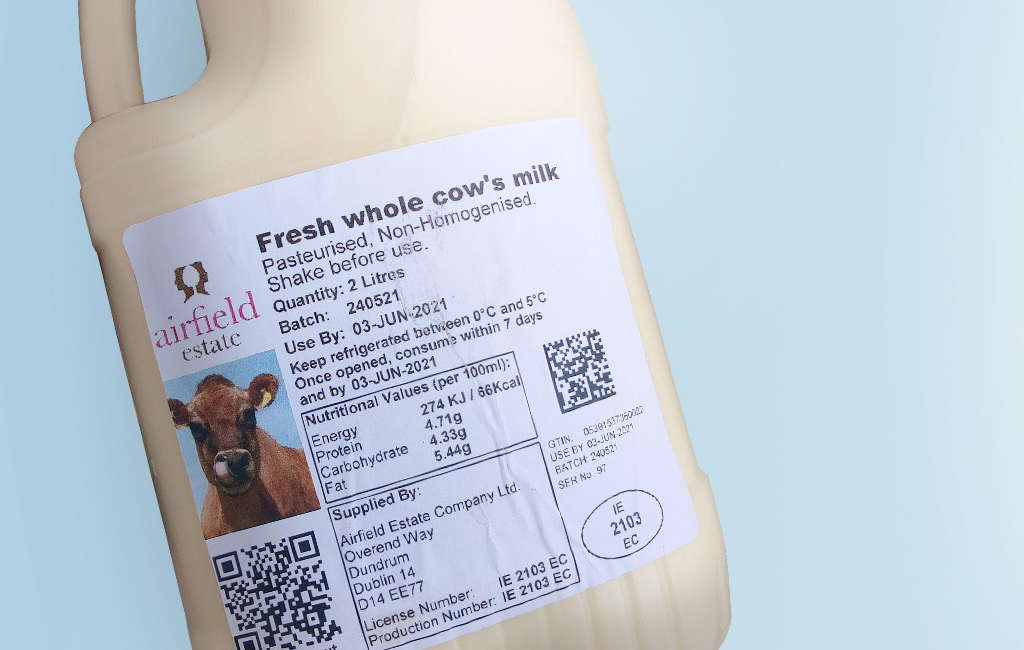
Airfield Estate produces, pasteurises, bottles, and sells its Jersey cow milk onsite, creating a closed-loop system from cow to consumer. Each bottle carries a QR code and GS1 DataMatrix barcode that encodes vital information such as the product’s Global Trade Item Number (GTIN), batch number, and expiry date. When scanned, consumers can instantly access details about the milk’s origin, production process, and even the farmer behind it.

For the farm, this innovation has streamlined operations. As farmer Brian Farrell explained, “Having the 2D barcode include the expiration date on the milk saves me an entire step in labelling. I used to have to put two labels on each milk carton; now it’s just one. It saves me time and money.” Beyond efficiency, the system also strengthens safety by enabling faster product recalls and better stock management, preventing food waste in the farm shop.
For agribusiness stakeholders in Kenya and across Africa, the lessons are clear. Traceability is no longer a luxury but a necessity. Consumers increasingly demand transparency about where their food comes from, and producers who embrace digital tools can gain a competitive edge. Imagine dairy cooperatives, horticultural exporters, or even smallholder farmers adopting similar systems—QR codes that link to batch-level data could reassure buyers, reduce losses, and open new market opportunities.
The Airfield Estate case shows that even small-scale producers can adopt global standards to meet consumer expectations. For Kenyan agribusiness, this is a call to action: start small, integrate traceability into everyday operations, and build consumer trust through openness.
Download the full Case study: https://www.gs1.org/insights-events/case-studies/airfield-estate-using-gs1-standards-improve-traceability-reduce-waste-and
Source: https://www.gs1.org/insights-events/case-studies


