


As consumers increasingly want to know where their food comes from, how it was produced and whether it meets expected quality and sustainability standards, traceability is becoming more than a supply-chain requirement—it is becoming a competitive advantage. A case study from Germany and Greece shows how combining IoT technology with GS1 Standards can connect information from the farm to the final product, giving farmers, buyers and consumers greater visibility into the food journey. The QUHOMAtrace solution demonstrates what is possible when farm data, product identification and supply-chain events are brought together and offers valuable lessons for Kenya’s growing agricultural sector.
What if a consumer could scan a product and see more than its name and price? What if they could discover where the crop was grown, when it was planted, how it was treated and even information captured by sensors in the field? A traceability initiative in Germany and Greece is showing how the combination of Internet of Things (IoT) technology and GS1 Standards can make this level of agricultural visibility possible.
Known as QUHOMAtrace, the solution was developed by Future Intelligence to address a growing challenge in the agri-food sector: how to make information about the journey of food accessible, reliable and shareable across the supply chain. Farms, cooperatives and other agri-food businesses increasingly need to respond to consumers and buyers who want more information about the products they purchase, including where they come from and how they were produced.

The challenge is not necessarily a lack of data. Modern farms can generate significant amounts of information through sensors, farm records and other digital technologies. The difficulty is connecting this information and ensuring that different players in the supply chain can understand and use it. QUHOMAtrace addresses this by bringing together IoT data, such as information from field sensors, with event-based traceability information showing what happened to a product and where it moved.
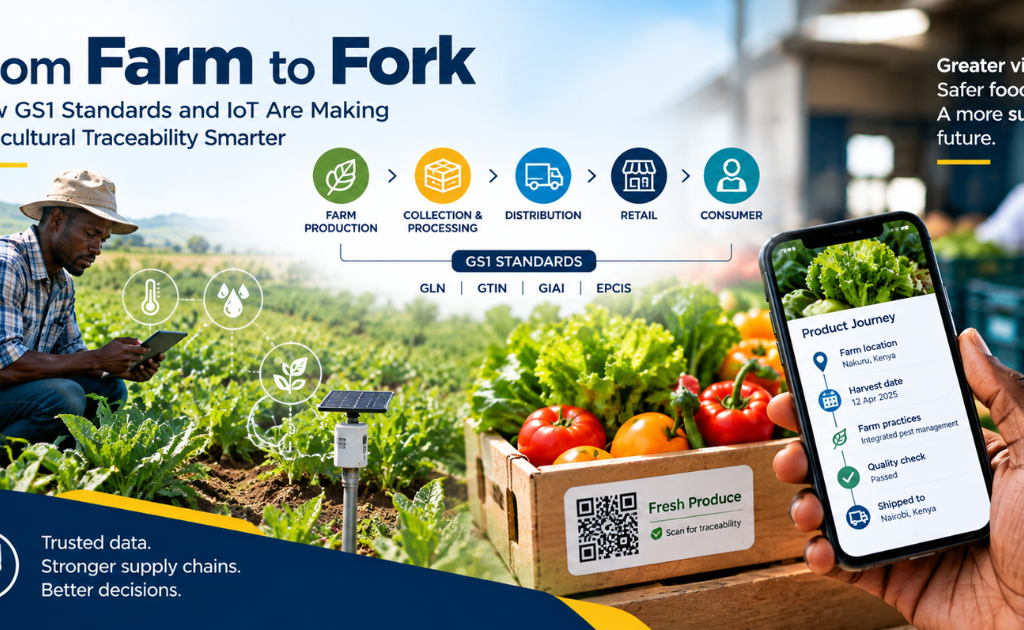
At the heart of the solution are GS1 identification and data-sharing standards. The system uses GS1 identifiers to give different elements of agricultural production a unique identity. Global Location Numbers (GLNs) can identify individual farm plots, while Global Trade Item Numbers (GTINs) combined with batch or lot numbers identify crops and their respective batches. Sensors monitoring the crops can also be uniquely identified using Global Individual Asset Identifiers (GIAIs).
This creates a digital connection between the physical farm and the information describing it. Instead of simply saying that a particular crop came from a particular farm, the system can connect the crop with information about the plot where it was grown, the batch it belongs to and the sensors associated with its production.
The technology becomes even more powerful when combined with EPC Information Services (EPCIS), the GS1 standard for sharing visibility event data. Through EPCIS, information about activities occurring during production can be captured and shared in an interoperable format. In the QUHOMAtrace case, information available for harvested products can include events that occurred before harvest, such as when the crop was planted, how it was treated and sensor-generated information from the field.
For farmers, this means that traceability can move beyond documenting where a product is at a particular point in the supply chain. It can begin much earlier, at the farm itself. Data generated during cultivation becomes part of the product’s digital story, helping create greater visibility between farmers, buyers, cooperatives and consumers.
The consumer-facing element is equally important. Future Intelligence tested the use of QR codes as data carriers that could connect a packaged food product to its traceability information. By scanning the QR code, consumers could access GS1 EPC-based information registered through the QUHOMA smart farming application. In practical terms, the technology creates a bridge between what happens in the field and the person purchasing the finished product.
For African agriculture, including Kenya, the concept presents an interesting opportunity. Farmers already collect information about planting, irrigation, fertiliser application, crop protection and harvesting. Increasingly, farms are also adopting digital tools and sensors. The lesson from QUHOMAtrace is that the value of this information increases when it can be connected, standardised and shared with other participants in the supply chain.
Consider a Kenyan farmer producing fresh vegetables for a supermarket or export market. Information about the farm plot, crop variety, production batch, treatments and environmental conditions could potentially be connected to the product’s identity. As the produce moves from the farm to a collection centre, processor, distributor and retailer, events along that journey could be captured and linked to the same traceability chain. The result would be greater visibility from farm to fork.
This does not mean that every farmer needs to immediately install sophisticated sensors or build a complex digital platform. The more fundamental lesson is the importance of establishing a common identification and information-sharing framework. GS1 Standards provide the common language that allows different systems and supply-chain participants to exchange information more effectively. The QUHOMAtrace case demonstrates that this approach can also be replicated across countries and sectors because it is based on internationally recognised standards.
There is also a sustainability dimension. Sensor data can help demonstrate why particular farming practices were necessary—for example, supporting decisions about irrigation or other field activities based on actual conditions. Such information can provide evidence of environmental practices rather than leaving farmers to communicate sustainability claims without supporting data. The case study also highlights the potential to promote locally produced food by giving consumers greater visibility into how and where it was produced.
For farmers, better traceability can therefore become more than a compliance exercise. It can provide information for better farm decisions, help demonstrate production practices to buyers, support quality and safety objectives and create new ways of communicating directly with consumers. The QUHOMAtrace case also points to opportunities for digital marketing, allowing farmers and cooperatives to use traceability information to tell the story behind their products.
The bigger lesson is that the future of agricultural traceability may not be about simply knowing where a product came from. It is about being able to connect the product with the events, locations, conditions and people involved in its journey. When IoT technologies generate the data and GS1 Standards provide the common language for identifying and sharing it, the result can be a more visible, connected and trusted food supply chain.
For Kenya’s agricultural sector, this presents a question worth considering: Can the data already being generated on farms become part of the product’s story? The QUHOMAtrace experience suggests that with the right standards and technologies, the answer can be yes—from the farm plot, through the supply chain, all the way to the consumer.
Source: GS1, Traceability Reference Book 2021 – QUHOMAtrace: Unique combination of IoT and traceability data provides unparalleled upstream visibility for agri-food stakeholders. The case study covers Germany and Greece and identifies EPCIS among the GS1 Standards used.https://www.gs1.org/insights-events/case-studies/quhomatrace-unique-combination-iot-and-traceability-data-provides-unparalleled


