

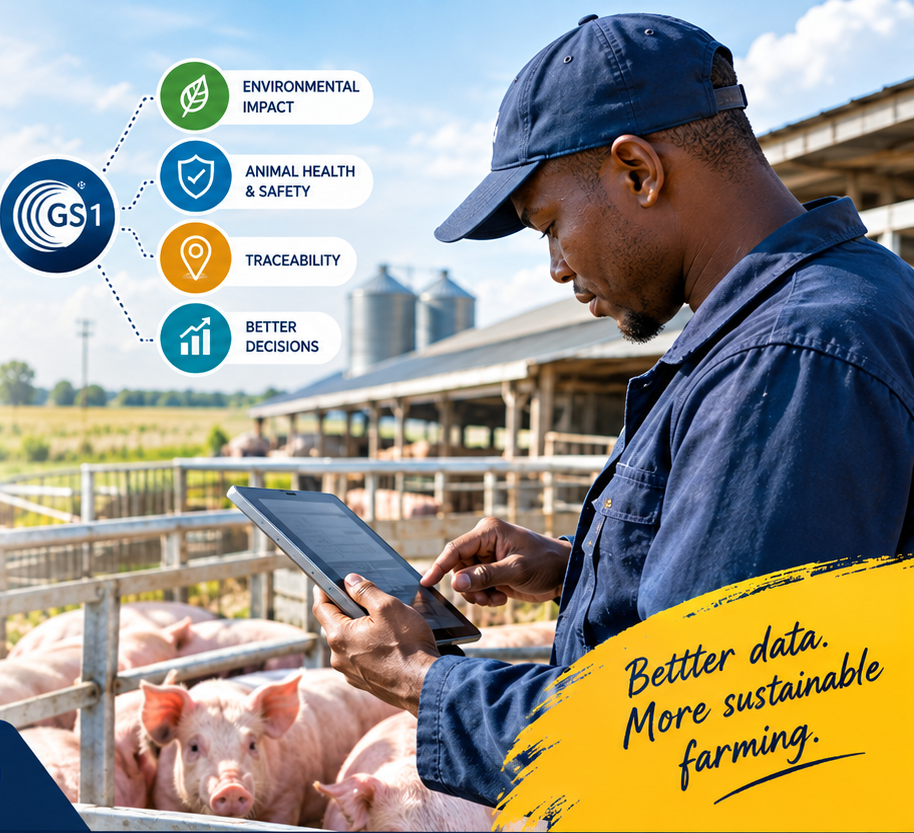

For a pork farmer, sustainability may sound like a distant conversation reserved for large commercial farms, environmental organisations or policymakers. But a family farm in Nebraska, United States, is showing that sustainability can be built into everyday farming decisions and that data and traceability can play a critical role in making those efforts measurable. Union Farms, a six-generation family pork and crop-producing operation in Ulysses, Nebraska, has placed GS1 Standards at the centre of its grain and pork operations as it works towards carbon neutrality and greater environmental responsibility.
The challenge Union Farms set out to address is one that farmers everywhere can recognise: how do you accurately measure the environmental impact of farming? Agriculture is constantly changing, while livestock production introduces additional considerations such as animal health, food safety, potential recalls and growing consumer interest in knowing where their food comes from. Without reliable ways to capture, measure, analyse and connect this information, it becomes difficult to understand the true impact of farming practices.
Union Farms responded by using GS1 Standards as a common language for identifying products, locations and processes across its crop and pork operations. Groups of animals are identified using Global Trade Item Numbers (GTINs), while locations are identified using Global Location Numbers (GLNs). Together, these identifiers provide a foundation for tracking information from the farm through the supply chain.

For Kenyan pork farmers, the important lesson is that traceability is about much more than knowing where a pig came from. It can also help farmers understand what happened during the animal’s production journey. At Union Farms, information is collected and matched to the appropriate GS1 identifiers, including how frequently workers checked on animals, what training they received, pharmaceuticals administered, water used for feeding and cleaning, feed consumed, power and fuel used, as well as temperature and humidity readings.
Imagine applying the same principle to a Kenyan pig farm. A farmer could progressively build a record of feed consumption, water use, energy consumption, animal-health interventions, environmental conditions and other important farm activities. Such information can reveal where resources are being used efficiently and where improvements may be possible. More importantly, it creates evidence that can be used to understand and communicate the farm’s performance rather than relying only on assumptions or estimates.
The approach extends beyond the piggery. Union Farms also collects detailed information from its crop operations, including irrigation water usage, soil moisture, fertiliser inputs and practices such as strip tilling, crop cover and manure use. These practices are designed to support carbon sequestration, minimise erosion, improve fertiliser efficiency and promote responsible use of water and energy. The farm’s crop and pork operations are therefore connected through data, creating a more complete picture of its overall environmental impact.
This is particularly relevant for farmers who integrate crop and livestock production. The Union Farms model demonstrates how information from different parts of an agricultural operation can be connected rather than treated as separate activities. Where crops become animal feed, for example, understanding the inputs and practices associated with crop production can contribute to a broader assessment of the livestock operation’s environmental footprint.
Union Farms is taking this data approach further through Electronic Product Code Information Services 2.0 (EPCIS 2.0), a GS1 Standard for creating and sharing visibility event data. The farm plans to use it to quantify the carbon impact of pork, by measuring key data elements at different stages of its crop and pork production processes. The goal is to move towards understanding environmental impact at a more granular level—including the potential to quantify carbon impact per pound of pork.
The benefits reported by Union Farms demonstrate why sustainability data can become more than an environmental exercise. The farm reports achieving carbon neutrality in certain years and generating additional income through carbon credits, averaging $10–$15 per ton of carbon per acre from different farming practices. It has also used historical data to understand the return on investment and the impact of practices and products already implemented.
For Kenyan farmers, this presents an important shift in perspective. Data generated on the farm can itself become valuable. When properly captured and connected, information can help farmers make better decisions, demonstrate improvements to buyers and supply-chain partners, and potentially create opportunities to participate in emerging markets that place a premium on verifiable sustainability practices. The Union Farms case study does not suggest that Kenyan farmers can simply replicate its carbon-credit model, but it does demonstrate the value of having reliable data on which sustainability claims and decisions can be based.
There is also a market dimension to this shift. Union Farms notes that consumers are increasingly asking questions about where their food comes from and its climate impact. Retailers and end-users are consequently asking suppliers for information that can demonstrate sustainability performance. GS1 Standards help create a common language through which this information can move across the supply chain.
For Kenya’s pork sector, this could become increasingly important as consumers, processors and other supply-chain actors seek greater visibility into how pork is produced. A farmer who can demonstrate how animals were raised, what inputs were used, how animal health was managed and how resources were consumed is in a stronger position to provide evidence of responsible production.
Perhaps the most important lesson from Union Farms is that sustainability does not begin with achieving carbon neutrality. It begins with measurement. Farmers need to understand what is happening on their farms before they can identify opportunities to improve it. As the case study highlights, many pork producers may already be implementing good practices, but without capturing and communicating the data, the extent of those improvements may remain invisible. GS1 Standards provide the common language that can help turn those activities into structured, shareable information.
For Kenyan pork farmers, the opportunity is therefore to start small and build progressively: identify important products and locations, capture relevant farm data consistently, connect information across production activities and use it to guide decisions. The objective is not simply to collect data for the sake of having records, but to turn information into better productivity, efficiency, traceability and sustainability.
Union Farms’ experience offers a glimpse into what the future of farming could look like—where sustainability is not simply a claim made by a producer, but something that can be measured, verified and communicated throughout the supply chain. For Kenya’s pork sector, embracing this approach could help farmers prepare for a market where the story behind the pork may become just as important as the product itself.
Source: GS1 US, Union Farms: How a Leading Pork Producer Achieves Carbon Neutrality in the Name of Sustainability, 2023. https://www.gs1.org/system/files/gs1-us-union-farms-case-study.pdf


