


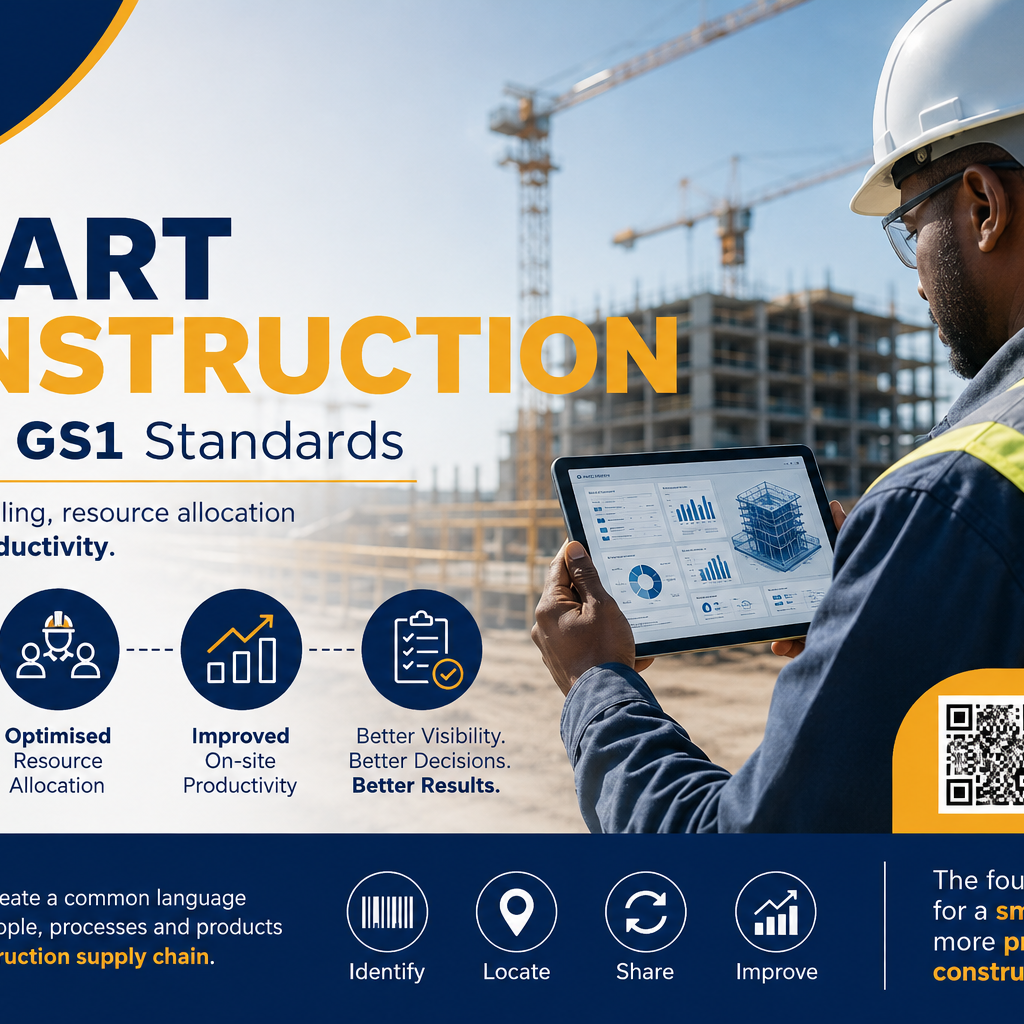

The construction industry is undergoing a digital transformation. As projects become larger and more complex, construction companies are increasingly turning to technology to improve efficiency, control costs and deliver projects on time.
Yet, technology alone cannot solve the challenges of fragmented information, poor visibility of materials and inefficient coordination between project stakeholders. Reliable and standardised data is the foundation of smart construction.
This is where GS1 standards can play an important role.

By providing a common way to identify construction materials, products, locations, organisations and logistics units, GS1 standards can help connect information across the construction supply chain—from the manufacturer and supplier to the warehouse, construction site and final installation.
Smarter scheduling through better visibility
Construction schedules depend heavily on the availability of materials, equipment and labour. When materials arrive late or the wrong products are delivered, planned activities can be disrupted, resulting in idle workers, delays and additional costs.
GS1 identification standards can help create greater visibility of materials as they move through the supply chain. A Global Trade Item Number (GTIN) can uniquely identify products, while a Global Location Number (GLN) can identify organisations and locations. Logistics units can also be identified using Serial Shipping Container Codes (SSCCs).
When this information is captured digitally and shared across systems, project teams can have better visibility of what materials are coming, where they are and when they are expected to arrive.
This allows construction managers to align material deliveries with project schedules rather than relying on manual updates, spreadsheets or phone calls.
Optimising resource allocation
Construction sites involve a constant movement of materials, tools, machinery and people. Without accurate information, resources can easily be misplaced, duplicated or left unused.
GS1 standards can support the digital identification of these resources, making it easier to track their movement and availability.
For example, a construction company could use standardised identification to know:
- Which materials have been delivered to a site
- Where specific materials are stored
- Which items have already been installed
- What materials are still required
- Which equipment is available or in use
- Where a particular asset or component is located
This level of visibility can help project managers make better decisions about where resources are needed and when, reducing unnecessary movement, shortages and waste.
Improving productivity on site
Productivity is often lost through simple processes: searching for materials, checking deliveries, confirming specifications or determining whether the right component has reached the right location.
Digital identification can simplify these activities.
For instance, workers can scan a barcode or 2D barcode on a construction product to access relevant information captured in connected systems. Instead of manually checking paperwork, teams can quickly confirm product identity, quantities and other relevant information.
The use of 2D barcodes, such as QR codes powered by GS1 standards, can further support the sharing of richer product information while maintaining a standardised identification structure.
This can help move construction sites from “Where is it?” and “What is it?” to “What do we need to do with it next?”
Connecting the construction supply chain
One of the biggest opportunities for smart construction is connecting information across different stakeholders.
A typical construction project may involve architects, contractors, manufacturers, distributors, logistics providers, engineers and subcontractors. Each may use different systems and ways of identifying products and assets.
GS1 standards provide a common language that can help these systems communicate.
When products, locations and logistics units are consistently identified, information can flow more efficiently between stakeholders. This creates the foundation for technologies such as Building Information Modelling (BIM), Internet of Things (IoT), digital twins and automated inventory systems to deliver greater value.
From materials to data
The future of construction is not simply about putting more technology on a construction site. It is about creating a connected environment where physical objects can be reliably linked to digital information.
A bag of cement, steel component, electrical fitting or prefabricated building element can have a unique digital identity. Once that identity is connected to relevant information, it becomes possible to improve visibility throughout its journey—from production and transportation to delivery, installation and maintenance.
This can support better planning, reduce errors and provide project teams with more reliable information for decision-making.
Building a more productive future
As the construction sector embraces digitalisation, standardised identification and data sharing will become increasingly important.
GS1 standards can provide the foundation for identifying products, locations and logistics units consistently across the construction ecosystem. Combined with digital technologies, they can help construction companies improve scheduling, resource allocation, material visibility and on-site productivity.
The smart construction site of the future will not only be connected it will be data-driven, traceable and interoperable.
And the journey towards that future begins with something deceptively simple: giving every important object, location and participant a reliable identity.


