

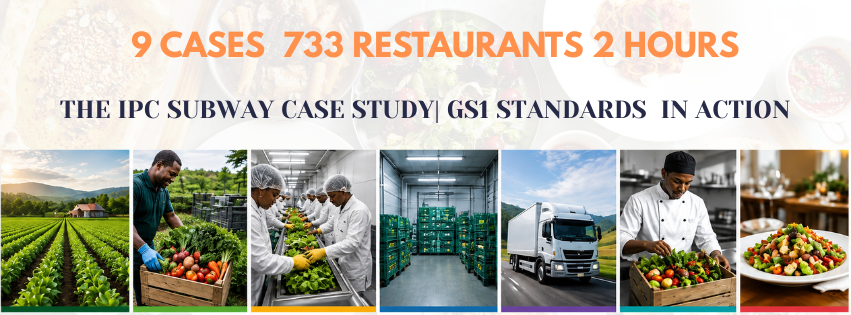

How a Subway recall showed the real value of knowing where your products are
A product recall is every business’s nightmare.
The moment a potentially unsafe product is discovered, the clock starts ticking. Where did it go? Which locations received it? How much is still in the supply chain? And most importantly, can it be found before it reaches the consumer?

For the Independent Purchasing Cooperative (IPC), the organisation supporting the Subway restaurant network, these questions became a real test of its traceability capabilities.
The answer demonstrated why good supply-chain data can be just as important as the physical movement of goods.
Nine cases that needed to be found
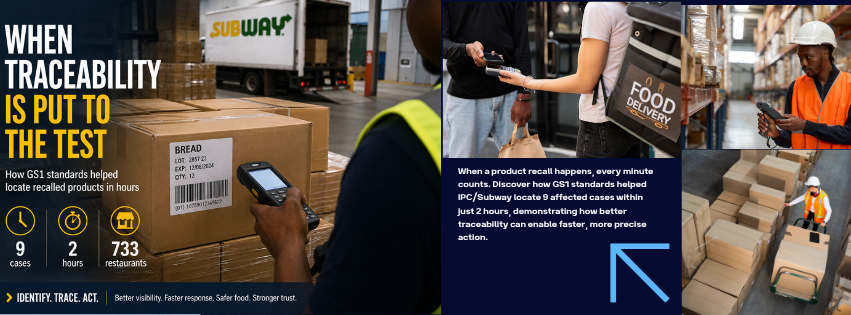
During a bread recall, IPC was notified that nine potentially contaminated cases had been distributed to restaurants.
Without precise traceability, finding them could have meant contacting or visiting hundreds of restaurants and searching through their stock.
Instead, IPC used its traceability system, built around GS1 standards, to follow the products through the supply chain.
Within two hours, all nine cases had been located.
The company avoided sending retrieval services to all 733 restaurants served by the distribution centre, saving approximately US$61,000 in retrieval costs.
The numbers tell an impressive story, but the bigger lesson is even more important:
Traceability does not prevent every problem. It helps businesses respond to problems faster and more precisely.
What made the difference?
The system was built on a simple principle: give products, locations and logistics units unique identities and connect the information they generate as they move through the supply chain.
IPC used GS1 identifiers including GTINs for products, GLNs for locations and SSCCs for logistics units, with GS1-128 barcodes helping capture information such as batch and expiry details.
This meant that when a problem arose, IPC was not starting with a blank sheet of paper.
It had data that could help answer:
What product is affected? Where did it go? And where is it now?
That is the difference between simply knowing that a product was shipped and having visibility of its journey.
Traceability is more than recalls
It is easy to think of traceability as something businesses need only when there is a crisis.
The IPC experience shows otherwise.
Reliable product data can support everyday operations, including inventory management, product withdrawals, expiry management and supply-chain efficiency. IPC reported that its broader traceability programme contributed to significant cost avoidance while improving visibility across the Subway supply chain.
For businesses, this means the investment in traceability can deliver value long before a recall ever happens.
What can businesses learn?
The IPC/Subway experience offers a practical starting point for businesses looking to strengthen their own supply chains.
Ask yourself:
- Can I uniquely identify my products?
- Can I identify the locations they move through?
- Can I trace batches or lots when necessary?
- If I needed to recall a product today, could I quickly identify where it went?
If the answer is no, it may be time to look at how product identification and data are being managed across the supply chain.
And this is where GS1 standards provide an important foundation. They help businesses establish a common language for identifying products, locations and logistics units, making it easier to share information across supply-chain partners.
The real value of knowing
For a consumer, traceability may simply mean confidence that a product is safe.
For a business, it can mean something much bigger: speed, accuracy, reduced waste, lower recall costs and protection of reputation.
The IPC/Subway experience reminds us that when a product needs to be found, every minute matters.
A supply chain that can answer “Where is it?” quickly is better equipped to protect its customers, its business and its brand.
Because traceability isn’t just about knowing where a product has been. It’s about knowing where it is when it matters most.
Source: This article has been adapted for The Tracker Media from the GS1 case study “IPC/Subway: Delivering the Promise of End-to-End Traceability Throughout the Subway System.” The case study documents IPC’s implementation of GS1 standards to improve traceability across the Subway supply chain.
Read the original GS1 IPC/Subway case study: https://bit.ly/4zneqiL


