

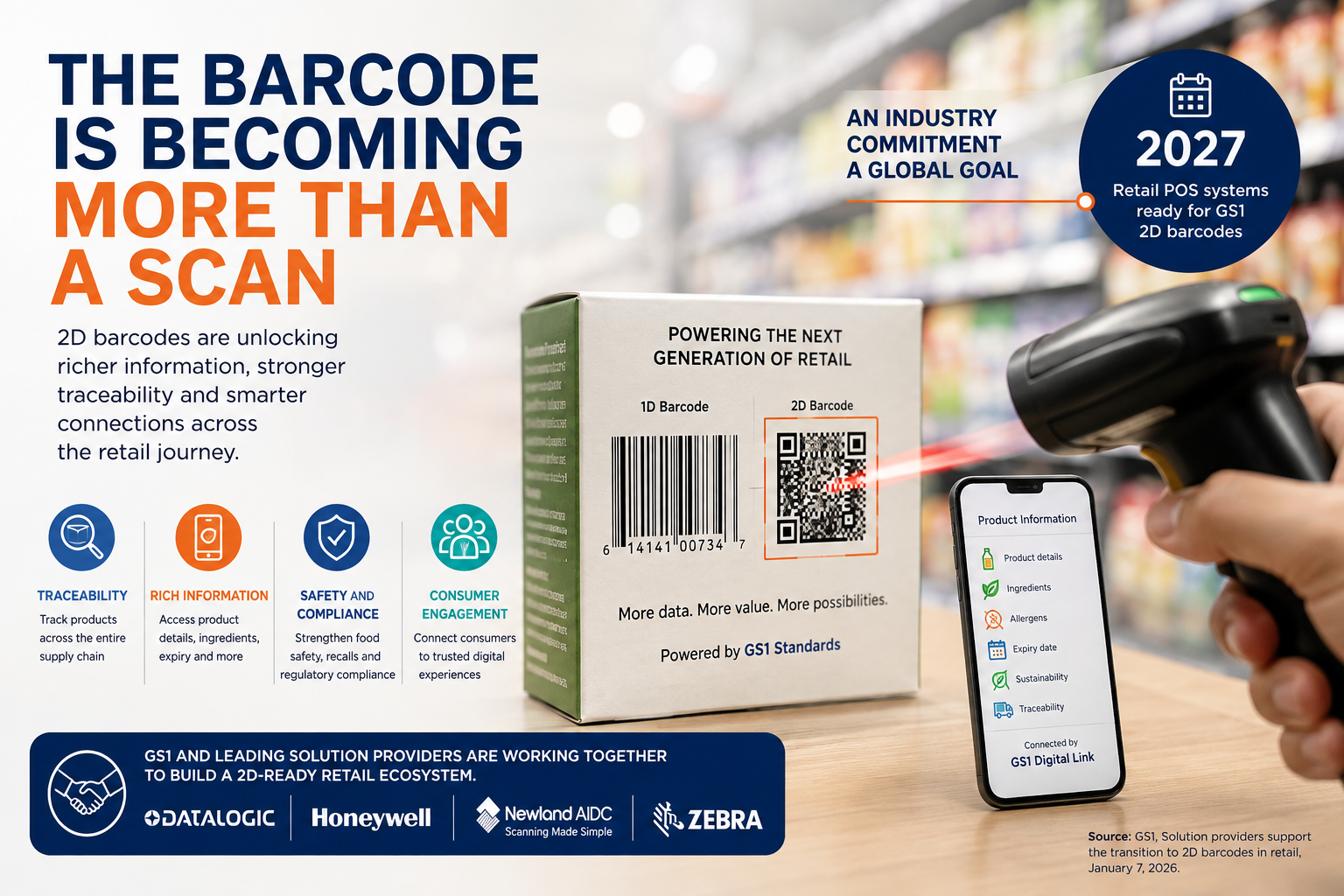

For decades, the barcode has been an essential part of modern retail. It has made checkout faster, supported inventory management and helped businesses identify billions of products moving through global supply chains. But the barcode is no longer just about scanning a product and retrieving its price.
As consumers demand more information about the products they buy, retailers seek greater visibility across their operations and regulators call for stronger traceability, the retail industry is moving towards a new generation of product identification: 2D barcodes.
This transition is gaining further momentum as technology solution providers strengthen their commitment to supporting the industry’s move towards 2D barcodes at retail points of sale.

In a statement issued in January 2026, GS1 highlighted the growing collaboration between the standards organisation and solution providers supporting the transition. The statement brings together commitments from leading technology companies including Datalogic, Honeywell, Newland AIDC and Zebra Technologies, all of which are working towards making retail scanning environments ready for the next generation of barcodes.
From scanning prices to connecting products
The traditional EAN/UPC barcode has played a fundamental role in retail for decades. Its primary purpose has been product identification, enabling retailers to retrieve information such as price and product details at checkout.
2D barcodes, however, can take product identification much further.
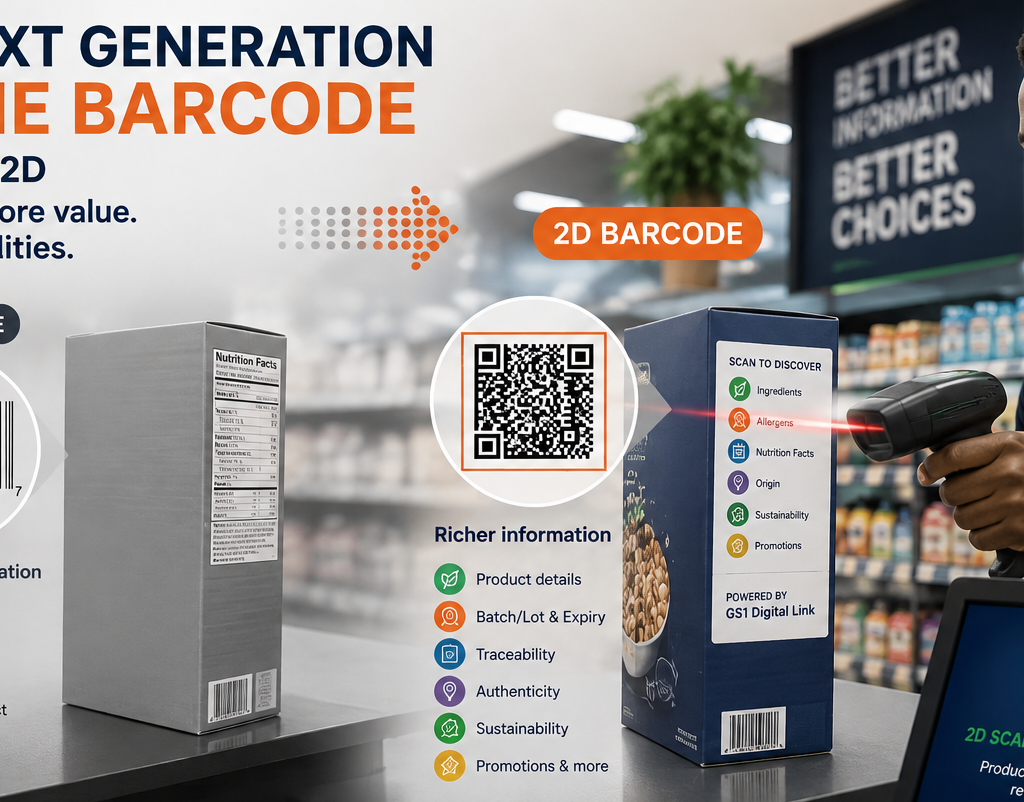
Unlike traditional linear barcodes, 2D symbols such as QR Codes powered by GS1 standards and GS1 DataMatrix can carry or connect to significantly more information. Depending on the application, they can support information such as batch or lot numbers and expiry dates, while GS1 Digital Link can connect a product to online information.
This creates a bridge between the physical product and the digital world.
A consumer could scan a product with a smartphone and access information beyond what can fit on the packaging. Retailers could use product-level data to strengthen traceability and inventory processes, while manufacturers could provide more timely and relevant information to customers.
GS1 notes that the addition of 2D barcodes can enable richer digital interactions with products at home, in stores or virtually anywhere.
The significance goes beyond convenience. Better product data can support food safety, product recalls, regulatory compliance, supply chain efficiency and consumer protection.
The industry is preparing for 2027
The move to 2D barcodes is not an overnight replacement of the traditional barcode. It is a gradual industry-wide transition.
Under GS1’s Ambition 2027, the retail industry has set a goal for retail point-of-sale systems globally to be capable of reading and processing defined GS1-standardised 2D barcodes, alongside existing linear barcodes, by the end of 2027.
Achieving this requires more than putting a QR Code on a product.
Retailers need compatible scanning hardware and software. Manufacturers need to determine which 2D barcode solution best meets their business and supply chain needs. Solution providers need to ensure that scanners, software and other technologies can reliably create, read and process the new barcodes.
This is why collaboration is central to the transition.
GS1’s solution-provider readiness guidance emphasises that 2D barcode adoption depends on the ability to print, position, scan, verify and connect the barcode to digital information in an interoperable way across the retail ecosystem.
The commitment from solution providers therefore represents an important piece of the wider transformation.
Technology providers are helping make the transition possible
The January 2026 GS1 statement demonstrates how technology companies are positioning themselves to support the emerging 2D ecosystem.
Datalogic highlights its portfolio of 2D-ready retail devices and the potential of GS1 Digital Link to deliver richer product information and improve traceability.
Honeywell points to its collaboration with GS1 in validating 2D scanning performance and integrating the technology across its portfolio.
Newland AIDC has committed to 2D compatibility across its retail scanning solutions and is participating in pilot programmes and technical validation.
Zebra Technologies has similarly committed to 2D compatibility across its retail scanning solutions, while highlighting potential benefits including traceability, food safety, consumer protection, supply chain efficiency and regulatory compliance.
These commitments demonstrate an important reality: Sunrise 2027 is not simply a barcode change. It is a technology ecosystem change.
The scanners, software, product information systems, packaging processes and supply chain systems that interact with the barcode all need to work together.
What does this mean for manufacturers and retailers?
For manufacturers, the transition presents an opportunity to rethink what product packaging can do.
A 2D barcode can become a gateway to trusted product information rather than simply an identifier used at checkout. Manufacturers can potentially provide consumers with information about ingredients, allergens, product usage, sustainability, recycling and other relevant digital content through connected data.
For retailers, the opportunity lies in stronger visibility and operational efficiency. More detailed product data can support improved inventory management, traceability, recalls and other processes across the supply chain. Consumers stand to benefit as well.
The product they pick from a shelf could become a digital touchpoint, allowing them to access information using a smartphone and make more informed purchasing decisions.
This shift is particularly relevant in sectors where product information and traceability are critical, including food, healthcare, consumer goods and agribusiness.
Why Kenya should pay attention
For Kenya and the wider African market, the transition to 2D barcodes presents both an opportunity and a call to prepare.
Retailers, manufacturers, technology providers and other supply chain stakeholders do not need to wait until 2027 to begin thinking about the transition. GS1 guidance encourages organisations to explore appropriate 2D barcode solutions and work collaboratively with their technology and trading partners.
Kenyan businesses that begin preparing early can better understand what changes may be required across packaging, product data, scanning technology, software and internal processes.
The transition also aligns with a wider digital transformation taking place across African supply chains. As businesses seek greater visibility, regulators demand stronger traceability and consumers become increasingly connected through smartphones, the ability to link physical products with trusted digital information becomes increasingly valuable.
For manufacturers, this could mean moving beyond asking, “Can my product be scanned?” to asking, “What trusted information can my product deliver?”
For retailers, the question becomes how their systems can transform a barcode scan into actionable product and supply chain information.
And for consumers, the future could mean that the humble barcode becomes a direct connection to the story, safety and authenticity of the products they purchase.
The next chapter has already begun
The traditional barcode is not disappearing overnight. GS1 guidance recognises that 1D and 2D barcodes will coexist during the transition while retail systems are upgraded. But the direction of travel is clear.
The industry’s commitment to building 2D-ready retail technology demonstrates that the next generation of barcodes is moving from concept to implementation.
For Kenya, this is an opportunity to be part of that transformation rather than catch up with it later.
The barcode that once simply helped identify a product is evolving into a digital gateway—one capable of connecting products, businesses, supply chains and consumers through trusted data.
Sunrise 2027 is therefore not simply about replacing a barcode. It is about reimagining what a barcode can do.
Source: GS1, “Solution providers support the transition to 2D barcodes in retail,” January 7, 2026. The feature also draws on GS1’s published guidance on Ambition 2027 and 2D barcodes at retail point-of-sale.
For more insights on how the evolution of barcodes is shaping retail, traceability and digital transformation in Kenya and beyond, read more stories on https://thetracker.media/


